
The Anti-Optimization Manifesto
Why Biohacking is Making Men Sicker and a Better Way to Get Fit and Stay Fit After 40

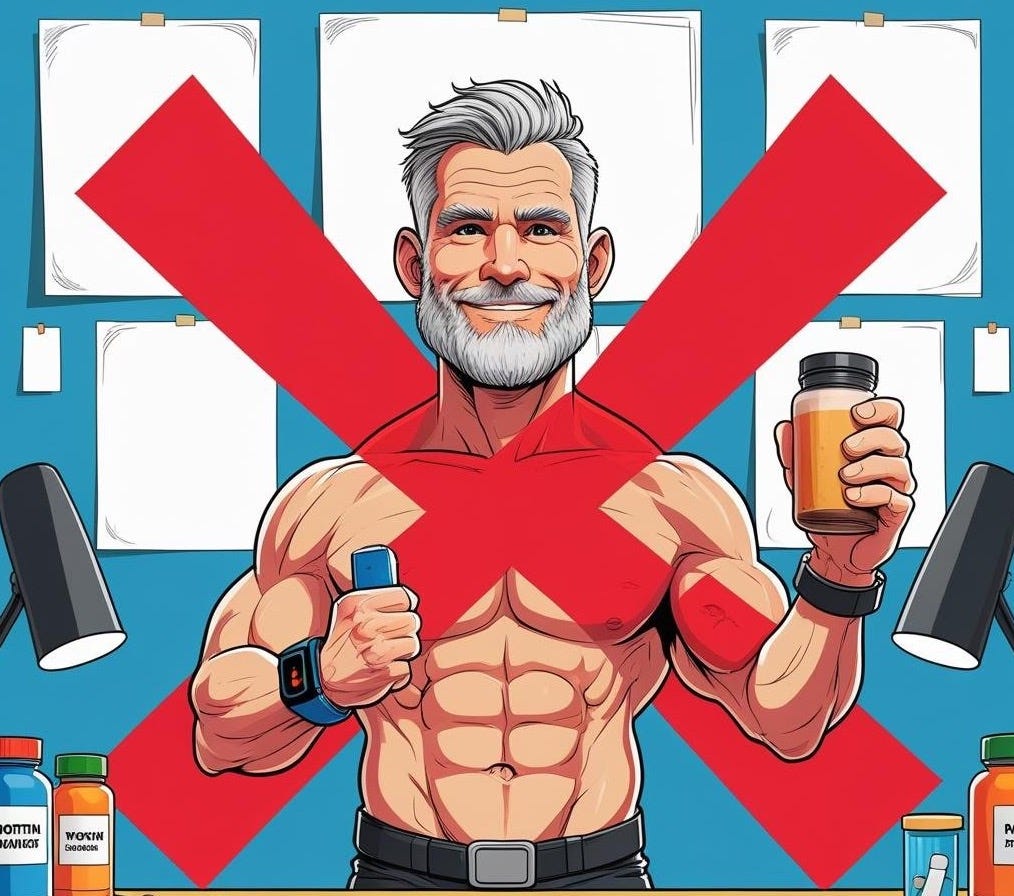
Your smartwatch just buzzed. Your HRV is down 12 points. Your sleep score dropped to 73. Your glucose spiked after that apple. Your step count is lagging. Your recovery metrics suggest you should skip the gym.
You're living in a prison of your own making, and the keys are in your pocket.
I've watched thousands of men transform their health over the past decade, and I've noticed something disturbing: the most obsessively tracked men are often the most anxious, disconnected, and paradoxically unhealthy. They've optimized themselves into a corner, trading their intuition for algorithms, their joy for data points, their humanity for metrics.
Welcome to the dark side of biohacking culture – and I should know, because I lived there for years.
My Journey Through the Optimization Obsession
At 45, I'm in the best shape of my life. But it wasn't always this way, and more importantly, the path here wasn't what you might expect.
Five years ago, I was the poster child for biohacking culture. I tracked everything – sleep stages, HRV, glucose, ketones, macros, steps, heart rate zones, recovery metrics. My phone had seventeen different health apps. I wore three different wearable devices simultaneously just to make sure I was getting accurate data. I could tell you my exact sleep efficiency percentage but couldn't remember the last time I'd simply enjoyed a meal without thinking about the macro breakdown.
I was optimized, quantified, and utterly miserable.
The breaking point came during a "perfect" week where all my metrics were dialed in. Sleep score: 94. HRV: trending up. Glucose: steady. Ketones: optimal. But I felt like garbage. I was irritable, anxious about my next meal, and constantly checking my devices for validation that I was "doing it right."
That's when I realized: I wasn't optimizing for health. I was optimizing for metrics. And there's a massive difference.
The Quantified Self Trap
We've been sold a lie that more data equals better health. That tracking every biomarker, monitoring every meal, and measuring every workout will unlock some secret level of vitality. But here's what actually happens: you become a slave to your devices, constantly evaluating whether you're "optimized" instead of simply living.
The human body isn't a machine that responds predictably to inputs. It's a complex, adaptive system that thrives on variability, not rigid protocols. When you track everything, you're not tuning into your body – you're tuning it out. You're replacing millions of years of evolutionary wisdom with the cold calculations of consumer-grade devices that often have massive error rates.
The result? Men who can tell you their blood sugar levels but can't tell you how they actually feel. Who know their sleep architecture but have forgotten what it means to wake up refreshed. Who can recite their macro ratios but have lost all pleasure in eating.
The Reductionist Trap
Biohacking culture has reduced the magnificent complexity of human health to a series of biological metrics. But you are not just a walking chemistry set. You are a thinking, feeling, spiritual being embedded in relationships and environment. Your health is influenced by your sense of purpose, your connection to others, your relationship with nature, and yes – your ability to find joy and play in life.
When you focus exclusively on optimizing biology, you neglect the very things that make life worth living.
You might have perfect biomarkers while your marriage falls apart.
You might have ideal body composition while your soul withers.
You might delay death while forgetting how to truly live.
The Rigidity Trap
Life is inherently unpredictable. Your stress levels fluctuate. Your sleep gets disrupted. Your schedule changes. Your appetite varies. But optimization culture promotes this fantasy of perfect consistency – the same bedtime, the same meals, the same workout schedule, day after day.
I learned this lesson the hard way during my tracking obsession. I remember canceling a spontaneous dinner with old friends because it would "mess up my eating window." I skipped a beautiful morning hike because my HRV suggested I needed rest. I turned down a pickup basketball game – something I genuinely loved – because it wasn't in my "optimal heart rate zone."
I was living my life according to algorithms instead of actually living it.
This rigidity makes you fragile. A truly healthy person adapts. They roll with the punches. They maintain their vitality despite variability, not because of its absence. The most resilient people throughout history didn't have HRV monitors, but they had something more valuable: the capacity to thrive in uncertainty.
The Effort Trap
The biohacking community has weaponized effort. Everything is about grinding, pushing, optimizing, maximizing. But health isn't just about hard work – it's about balance. Where's the emphasis on rest, on play, on simple enjoyment? When did we decide that suffering through ice baths and strict protocols was more valuable than laughing with friends over a meal?
A life without pizza is not one I want to live.
The obsession with effort often masks a deeper fear: the fear of mortality. All this tracking and optimizing is really about control – the illusion that we can hack our way out of the fundamental uncertainty of being human.
But what if acceptance, rather than control, was the path to true well-being?
A Different Path Forward
I'm not advocating for complete abandonment of health optimization. Instead, I'm proposing a more thoughtful approach focused on what I call the "Big Rocks" – the fundamental pillars that actually move the needle on health and vitality without the obsessive nature of biohacking.
This shift happened gradually for me. At 45, as an aging athlete who still wants to perform at a high level, I had to get honest about what actually mattered. I stopped tracking my sleep and started focusing on consistent bedtimes. I ditched the rigid eating restrictions and started eating intuitively around mostly whole foods and adequate protein. I threw away the heart rate monitor and started moving my body in ways that brought me joy.
The result? I'm stronger, leaner, and more energetic than I was in my twenties. More importantly, I actually enjoy the process.
Here are the Big Rocks that transformed my health:
Sleep Consistency: Not perfect sleep scores, but consistent, restorative rest that leaves you feeling energized.
Body Composition: Not aesthetic perfection, but maintaining healthy muscle mass and body fat levels that support metabolic function, high energy, and lots of capacity with your body.
Functional Movement: Less structured work and more play. Not chasing numbers in the gym, but ensuring your body can perform the basic physical tasks life demands so that you can play more and experience more joy with your body.
Nutrition Fundamentals: Not macro counting or rigid rules, but awareness with basic nutrition basics so that you find a way to eat whole foods most of the time.
Stress Management: Not perfect HRV scores, but developing resilience and the capacity to handle life's inevitable challenges through simple practices like breath work, yoga, and meditation.
These pillars are measurable without being obsessive. They're simple without being simplistic. They honor both the science of health and the art of living.
Your Call to Action
Ready to break free from the optimization trap? Join my 10-week NHF Rebuild Program – starting August 4th, 2025 — a comprehensive strength, mobility, and nutrition system designed specifically for men over 40 who want to lose weight and build muscle without becoming a slave to metrics.
Learn the "Big Rocks" approach that helped me get in the best shape of my life at 45, focusing on sustainable practices that honor both science and practicality. You'll discover how to build real strength and vitality through functional movement, smart nutrition, and stress management techniques that work with your body, not against it.
Great post!! Society needs more of this. Influencer culture - and its emphasis on biohacking - makes healthy living appear out of reach to the millions upon millions of people that simply need - as you put it - a greater focus on the “the big rocks.”
I enjoy tracking, but let’s be real. This stuff is mostly what all call wellertainment. There are people I have met as you described above who become enslaved to these devices, but then there are others who just treat them more in the entertainment realm. I tend to fall into that. some of the devices I find genuinely useful such as the heart rate monitor I use for my cardio, but mostly knowing my sleep, efficiency and my HRV it’s just sort of a fun interesting window into my biology. As you point out above, the idea is that if you’re going to use technology, it should improve your life if it’s not ditch it. Humans are extraordinarily complex and trying to optimize for a bio marker is foolish and certainly not much fun. Great work Nick. Thank you for sharing.